18 Jul 2026
Accumulator Mechanics Explored: How Multi-Leg Structures Differ Across Major UK Operators and Influence Payout Calculations
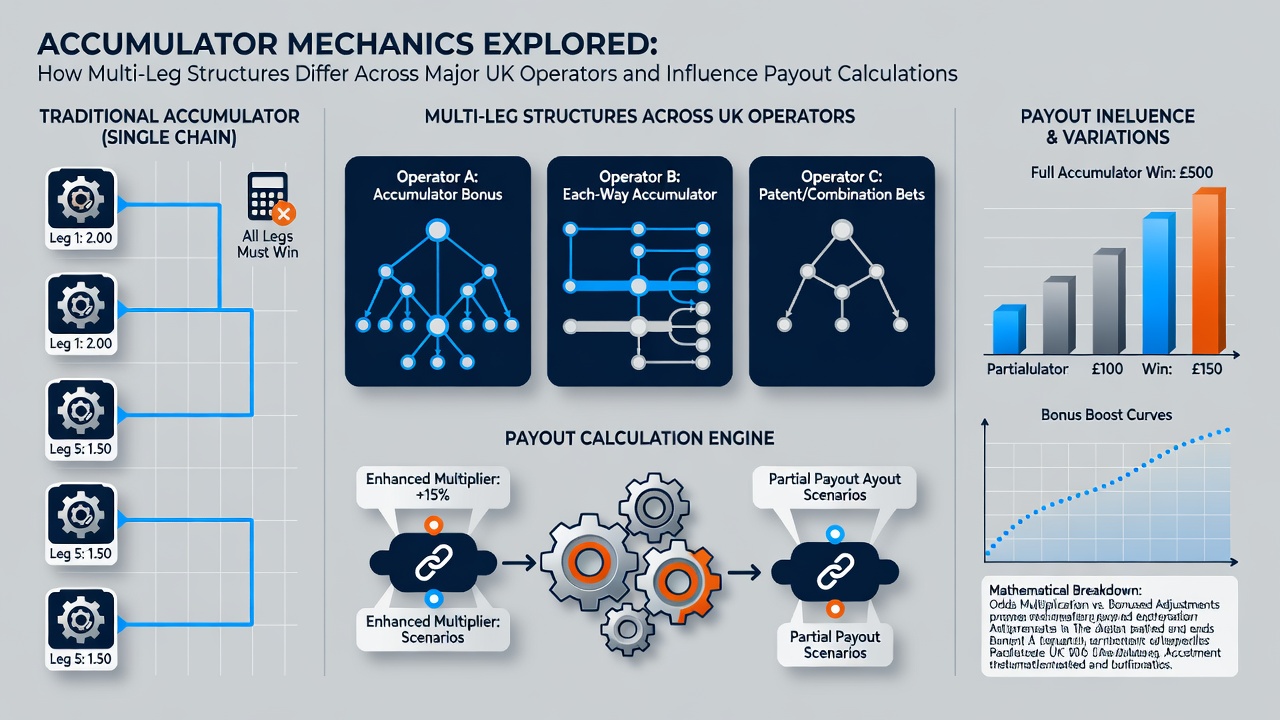
Accumulators combine multiple selections into a single wager where each leg must succeed for the overall bet to pay out, and UK operators apply distinct structural rules that alter both the risk profile and final returns. Data from industry reports shows these variations affect how bettors approach multi-leg structures, particularly when operators adjust minimum leg counts or apply conditional bonuses that scale with the number of selections.
Core Structure of Accumulator Bets
Each selection carries its own odds, yet the combined payout multiplies those odds together rather than adding them, which creates exponential growth in potential returns while simultaneously increasing the probability of total loss. Observers note that operators enforce different thresholds for what qualifies as a valid accumulator, including rules on the minimum number of legs required before any bonus multipliers activate or before certain payout caps come into play.
Void legs receive treatment that varies by platform, with some operators removing the selection and recalculating the remaining accumulator at adjusted odds while others treat voids as non-runners that leave the bet intact at the original multiplier. These mechanical differences become especially visible during periods of fixture congestion when postponements occur more frequently.
Operator-Specific Variations in Leg Requirements and Bonuses
Major UK platforms diverge in how they structure accumulator bonuses, with some awarding percentage boosts only after five or more legs while others extend smaller enhancements to three-leg combinations. Payout calculations therefore shift depending on whether an operator applies the bonus before or after the base multiplier, and whether the bonus itself carries an upper limit that caps total returns regardless of how many additional legs succeed.
One platform might exclude certain markets such as handicap bets from accumulator bonuses, whereas another includes them but applies a reduced multiplier to those selections. Research indicates these policy distinctions influence which combinations bettors select when chasing enhanced returns, particularly in football where goalscorer and correct-score markets often carry different eligibility rules across sites.

Payout Calculation Mechanics and Caps
The base calculation multiplies the decimal odds of each leg, yet operators impose different maximum payout thresholds that truncate returns once a certain figure is reached. Data shows these caps often reset or scale according to the total number of legs, so a six-leg accumulator might face a higher ceiling than a four-leg version on the same platform.
Some operators apply stepped bonuses that increase at specific leg milestones, while others offer flat percentage uplifts that remain constant once activated. When a leg is voided, the recalculation method determines whether the bonus percentage stays attached to the revised leg count or adjusts downward, creating scenarios where identical selections produce different net returns depending on which operator processes the bet.
According to findings published by the European Gaming and Betting Association, variations in these calculation rules contribute to measurable differences in average returns across platforms during high-volume betting periods. In July 2026, fixture schedules across multiple European leagues created additional opportunities for accumulators, and operators responded by adjusting bonus thresholds in real time to manage liability.
Impact on Bettor Strategy and Platform Choice
Those who study accumulator behaviour observe that bettors often migrate between operators based on which site currently offers the most favourable leg-count bonus or the highest payout ceiling for a given sport. Cash-out functionality also interacts with accumulator structures, because early settlement offers reflect the remaining legs and any active bonuses at the moment of the request.
Platforms that recalculate accumulators more generously after voids tend to attract users who build larger multi-leg bets, whereas sites with stricter bonus retention rules see more conservative selections. A report from the Responsible Gambling Council highlights how these mechanical differences shape overall engagement patterns without altering the fundamental requirement that every leg must win for the bet to succeed.
Conclusion
Accumulator mechanics across UK operators rest on shared principles of multiplied odds and conditional bonuses, yet the precise implementation of leg thresholds, void handling, and payout caps produces distinct outcomes for otherwise identical selections. These structural differences continue to guide how bettors construct and manage multi-leg wagers, especially when market conditions shift rapidly.